MCode vs Kolbe A Index
The Kolbe A Index reveals how someone instinctively executes. MCode reveals what makes that execution worth showing up for. Organizations that want both high performance and lasting engagement need insight into both dimensions.

Hiring beyond behavioral fit
Organizations use the Kolbe A Index to match a candidate’s instinctive problem-solving style to the demands of a role, predicting how they will naturally gather information, organize, manage risk, and handle tangible challenges. What it doesn’t address is whether the candidate will be energized by the work.
- MCode reveals whether a candidate’s Motivations align with the demands of a role, the challenges it presents, and the outcomes it produces.
- Because their motivations are different, two candidates can have the same Kolbe MO and perform a role completely differently in terms of engagement, longevity, and satisfaction.
- Organizations that add MCode to their hiring process make decisions that hold up beyond onboarding, reducing the costly pattern of hiring the right skills for the wrong fit.
Knowing how someone will execute gets you a capable hire. Knowing what will fuel that execution gets you a committed one.


Engagement leaders can act on
Leaders who know their team members’ Kolbe profiles understand how each person will approach problems and where conative stress is likely to occur. MCode gives leaders the motivational layer they need to understand why someone is disengaging and what to do about it.
- This kind of motivational intelligence moves leadership from intuition to precision, making it possible to address disengagement before it becomes a performance problem or a departure.
- MCode identifies what each team member needs from their work, their assignments, and their environment to stay fully invested, not just functionally productive.
- When a leader can see which Motivations an individual’s current role is engaging and which it’s consistently ignoring, they have a specific, actionable basis for conversation and adjustment.
Kolbe tells leaders how people work. MCode tells them what keeps people working at their best.
Retention driven by motivational alignment
Kolbe’s own research shows that employees working against their conative MO are significantly more likely to leave for job-related reasons. The motivational equivalent is equally well documented: people whose work fails to engage their core Motivations disengage, underperform, and eventually leave.
- MCode makes it possible to identify motivational misalignment before it becomes a retention problem, revealing which roles, assignments, and team structures will sustain engagement over time.
- When development opportunities, project assignments, and career paths align with an individual’s top Motivations, people don’t just perform well — they feel fulfilled by their work and have fewer reasons to look elsewhere.
Organizations that understand both the conative and motivational dimensions of their people build cultures where high performers stay, not because they have to, but because the work genuinely suits them.

Conative assessment vs. Motivational assessment
The Kolbe A Index is a conative assessment. It measures the instinctive part of the mind, distinct from the cognitive and affective dimensions. Developed by Kathy Kolbe in the 1970s, it identifies an individual’s MO (method of operation) across four Action Modes: Fact Finder, Follow Thru, Quick Start, and Implementor. A four-number result places each individual on a spectrum within each mode, revealing their most natural and productive approach to execution.
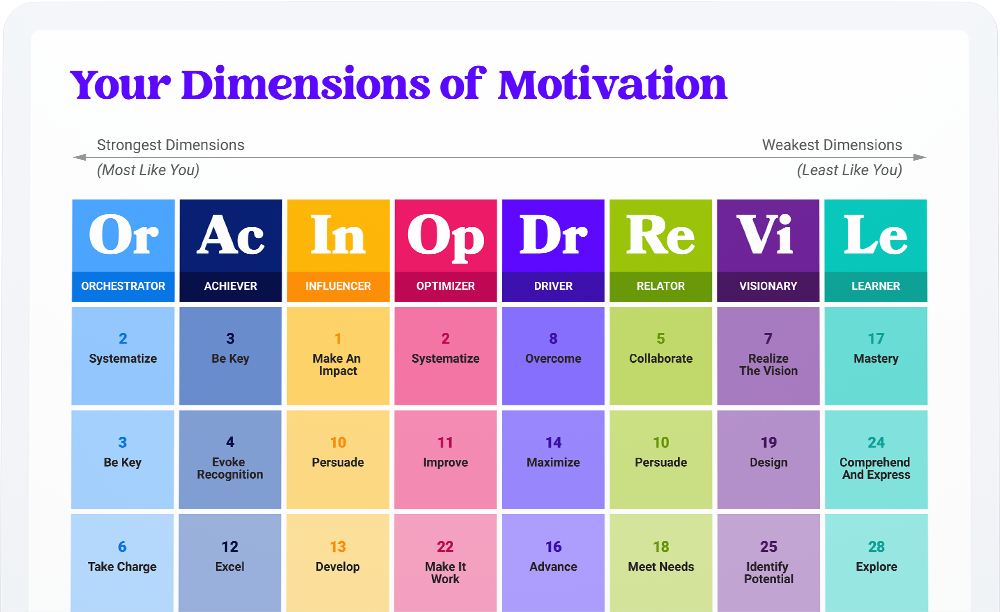
The Motivation Code (MCode) assessment identifies an individual’s unique ranking of 32 Motivations mapped across 8 Motivational Dimensions: Achiever, Driver, Influencer, Learner, Optimizer, Orchestrator, Relator, and Visionary. Built on 60+ years of motivational science and the analysis of over one million personal achievement stories, MCode reveals what drives someone to engage, persist, and perform at their best, and what depletes them. Where Kolbe identifies the instinctive method through which someone executes, MCode identifies the motivational conditions under which that execution will be fully energized and deeply satisfying.
Instinct vs. motivation:
Kolbe measures striving instincts, the innate conative tendencies that determine how a person will naturally take action when free to be themselves. MCode measures motivational drivers, the intrinsic forces that determine whether the work someone is doing with their instincts connects with what genuinely fuels them. Both instincts and motivations are fixed and consistent throughout life, but a person can be operating fully within their instinctive method of operation (MO) and still feel disengaged if the work fails to activate their core Motivations.
Execution vs. fulfillment:
Kolbe predicts how someone will execute, their natural approach to gathering information, organizing, managing uncertainty, and handling tangibles. MCode addresses what needs to be true about the work for that execution to feel worth doing. Kolbe’s own research identifies conative stress, the performance and retention risk that occurs when people work against their instinctive MO. MCode identifies the motivational equivalent: the disengagement and attrition risk that occurs when work consistently fails to connect with what drives someone at their core.
Action-mode profile vs. motivational spectrum:
Kolbe results are expressed as a four-number profile across the four Action Modes, placing an individual on a spectrum within each mode and predicting behavior in specific execution contexts. MCode results are expressed as a stacked ranking of 32 Motivations mapped across 8 Dimensions, revealing the full motivational spectrum from what most energizes an individual to what most depletes them. Kolbe profiles describe consistent action patterns; MCode profiles describe the conditions under which those patterns will generate sustained engagement and fulfillment.
MCode vs Kolbe A Index Features Comparison
The MCode assessment and the Kolbe A Index address two distinct and complementary dimensions of human performance. Kolbe identifies how people instinctively take action, their natural method of problem-solving, organizing, and executing. MCode identifies what drives them to take action and what sustains their engagement over time. Used together, they provide a complete picture of how someone performs at their best and what keeps them performing at that level.
MCode
Kolbe A Index
Assessment concept
Uncovers the intrinsic motivations that fuel engagement, performance, and fulfillment, the “why” behind what drives someone to do their best work and find it deeply satisfying.
Measures instinctive problem-solving and action-taking tendencies, the “how” of the way someone will naturally execute when free to be themselves.
Assessment framework
A ranking of 32 Motivations mapped to 8 Motivational Dimensions: Achiever, Driver, Influencer, Learner, Optimizer, Orchestrator, Relator, and Visionary.
A four-number MO (method of operation) scored across four Action Modes: Fact Finder, Follow Thru, Quick Start, and Implementor.
Assessment origins
Based on the System for Identifying Motivated Abilities (SIMA), developed by Art Miller in the 1950s to study the intrinsic motivations of high-performing individuals. Originally administered through in-depth interviews. Technology brought it online, improving consistency and scalability. Unified under the Motivation Code brand in 2022, with enhanced reports, team engagements, and certification.
Developed by Kathy Kolbe in the 1970s, building on her father Eldon Wonderlic’s work in cognitive assessment. Founded on the concept of conation, the instinctive action-taking part of the mind identified by philosophers as far back as Plato and Aristotle. Kolbe Corp celebrated its 50th anniversary in 2025 and has administered the assessment to nearly two million people across six continents.
Assessment science
Grounded in 60+ years of empirical science integrating narrative psychology, behavioral psychology, and motivational research, built on the analysis of over one million personal achievement stories to identify the motivational patterns that drive fulfillment and high performance.
Rooted in the science of conation, the third part of the mind, distinct from the cognitive and affective dimensions. Independent research validates 90%+ test-retest reliability over 20 years. A study at Arizona State University confirmed the Kolbe A Index is not biased by gender, age, or race.
Assessment experience
Individuals share four personal achievement stories and answer questions about those experiences, rating satisfaction on a 1-10 scale.
Individuals respond to 36 forced-choice questions about how they approach tasks. Results describe the individual’s MO and their conative strengths.
Time to complete
Approximately 30 minutes.
Approximately 10-20 minutes.
Assessment consistency
Results are grounded in real, lived experiences and the emotions tied to them. Core Motivations remain consistent throughout life. Results are available only through Motivations AI, ensuring the assessment experience and report are always the same.
90%+ test-retest reliability over 20 years, with 92%-97% consistency in each Action Mode after 10-15 years. Results are considered stable for a lifetime because instincts are innate. A “Transition” result indicates a temporary inability to work in one’s natural style, typically due to professional or personal pressure.
Assessment results
Reveals the motivational patterns that have driven every significant achievement in an individual’s life, what fuels and depletes them, what they need from their work and environment to sustain high performance, and why certain roles and assignments feel deeply satisfying while others feel like an obligation.
Reveals an individual’s natural action-taking style across four domains, predicting how they will instinctively gather information, organize, manage uncertainty, and handle tangible challenges. Includes a breakdown of how conative energy is distributed across the four Action Modes.
Assessment application
Hiring and job fit, employee engagement, talent development, retention, burnout prevention, team building, leadership development, productivity, and performance management.
Hiring and role alignment, team composition, reducing conative stress, personal productivity, and improving communication and collaboration by understanding instinctive differences.
Assessment challenges
Individuals may feel pressure to choose stories that cast them in the best light, or find it difficult to decide which personal and professional stories to share.
When someone has been working against their natural MO for an extended period, it can produce unreliable results that require them to take the assessment again.
MCode
Kolbe A Index
Assessment concept
Uncovers the intrinsic motivations that fuel engagement, performance, and fulfillment, the “why” behind what drives someone to do their best work and find it deeply satisfying.
Measures instinctive problem-solving and action-taking tendencies, the “how” of the way someone will naturally execute when free to be themselves.
Assessment framework
A ranking of 32 Motivations mapped to 8 Motivational Dimensions: Achiever, Driver, Influencer, Learner, Optimizer, Orchestrator, Relator, and Visionary.
A four-number MO (method of operation) scored across four Action Modes: Fact Finder, Follow Thru, Quick Start, and Implementor.
Assessment origins
Based on the System for Identifying Motivated Abilities (SIMA), developed by Art Miller in the 1950s to study the intrinsic motivations of high-performing individuals. Originally administered through in-depth interviews. Technology brought it online, improving consistency and scalability. Unified under the Motivation Code brand in 2022, with enhanced reports, team engagements, and certification.
Developed by Kathy Kolbe in the 1970s, building on her father Eldon Wonderlic’s work in cognitive assessment. Founded on the concept of conation, the instinctive action-taking part of the mind identified by philosophers as far back as Plato and Aristotle. Kolbe Corp celebrated its 50th anniversary in 2025 and has administered the assessment to nearly two million people across six continents.
Assessment science
Grounded in 60+ years of empirical science integrating narrative psychology, behavioral psychology, and motivational research, built on the analysis of over one million personal achievement stories to identify the motivational patterns that drive fulfillment and high performance.
Rooted in the science of conation, the third part of the mind, distinct from the cognitive and affective dimensions. Independent research validates 90%+ test-retest reliability over 20 years. A study at Arizona State University confirmed the Kolbe A Index is not biased by gender, age, or race.
Assessment experience
Individuals share four personal achievement stories and answer questions about those experiences, rating satisfaction on a 1-10 scale.
Individuals respond to 36 forced-choice questions about how they approach tasks. Results describe the individual’s MO and their conative strengths.
Time to complete
Approximately 30 minutes.
Approximately 10-20 minutes.
Assessment consistency
Results are grounded in real, lived experiences and the emotions tied to them. Core Motivations remain consistent throughout life. Results are available only through Motivations AI, ensuring the assessment experience and report are always the same.
90%+ test-retest reliability over 20 years, with 92%-97% consistency in each Action Mode after 10-15 years. Results are considered stable for a lifetime. A “Transition” result indicates a temporary inability to work in one’s natural style.
Assessment results
Reveals the motivational patterns that have driven every significant achievement in an individual’s life, what fuels and depletes them, what they need from their work and environment to sustain high performance, and why certain roles and assignments feel deeply satisfying while others feel like an obligation.
Reveals an individual’s natural action-taking style across four domains, predicting how they will instinctively gather information, organize, manage uncertainty, and handle tangible challenges. Includes a breakdown of how conative energy is distributed across the four Action Modes.
Assessment application
Hiring and job fit, employee engagement, talent development, retention, burnout prevention, team building, leadership development, productivity, and performance management.
Hiring and role alignment, team composition, reducing conative stress, personal productivity, and improving communication and collaboration by understanding instinctive differences.
Assessment challenges
Individuals may feel pressure to choose stories that cast them in the best light, or find it difficult to decide which personal and professional stories to share.
When someone has been working against their natural MO for an extended period, it can produce unreliable results that require them to take the assessment again.

A Kolbe A Index alternative?
Maybe… Maybe not!
Kolbe identifies something most assessments miss entirely: the instinctive, conative dimension of human performance. It explains how people will naturally execute, regardless of personality, values, or motivation. MCode addresses a different dimension entirely, not how people act, but what drives them to engage fully with that action and find it worth doing.
Kolbe’s own framework for the three parts of the mind, cognitive, affective, and conative, points directly to why MCode is its natural complement. Kolbe places motivation in the affective domain, correctly noting that it is distinct from conation. MCode goes deeper into that motivational layer than any affective tool, grounding results in personal achievement stories rather than preferences or self-reported personality.
Together, the Kolbe A Index and MCode cover the two dimensions of performance most predictive of sustained high performance and retention: how people execute and what fuels that execution.
Here are five ways using both assessments creates better outcomes:
Smarter hiring with fewer costly mismatches:
Kolbe identifies candidates whose instinctive problem-solving style matches the everyday demands of a role. MCode adds the question of whether the candidate will be energized by the work itself. A candidate can be a strong conative fit for a role and still disengage if the work fails to activate their core Motivations. Organizations that evaluate both dimensions make hiring decisions that hold up beyond the onboarding phase.
Conative and motivational alignment in role design:
Kolbe research shows that employees whose MO matches their role requirements have higher retention rates. MCode identifies the same pattern from the motivational side: people whose work consistently engages their top Motivations perform better and stay longer. Leaders who understand both dimensions can design roles that honor instinctive strengths and motivational needs, reducing the risk of both conative stress and motivational misalignment.
Team composition that accounts for the full performance picture:
Kolbe helps leaders build teams with a healthy distribution of conative strengths, ensuring the right balance of fact-finders, organizers, innovators, and builders. MCode adds the motivational layer, identifying where team members are energized by their contributions and where they’re carrying responsibilities that deplete them. Teams that are strong across both dimensions collaborate more effectively, sustain performance longer, and experience less friction and burnout.
Leadership that addresses both how and why:
Leaders who know their team members’ Kolbe profiles understand how each person will approach tasks and what conative stress to watch for. Leaders who also know their team members’ MCode results understand what conditions will sustain or drain engagement. This combination makes personalized leadership actionable for understanding people, and designing assignments and growth opportunities.
Retention rooted in the full picture of performance:
Conative stress, working consistently against one’s instinctive MO, is a documented driver of absenteeism and attrition. Motivational misalignment produces the same outcome through a different mechanism. Organizations that monitor both dimensions can identify at-risk employees earlier, intervene with meaningful role adjustments, and build cultures where people have every reason to stay.
The MCode assessment powers job satisfaction and high-performing teams
Headhunters, executive coaches, recruiters, and leaders have been using this workplace assessment for decades, with companies like The Disney Institute, Merk, IBM, Aetna, The Mayo Clinic, New York Life, and Motorola, to identify job fit, increase engagement, develop talent, and build team cohesion.
Discover the MCode difference!