MCode vs Culture Index
Culture Index profiles how people are behaviorally wired and whether they fit a role. Motivation Code reveals what drives each person to engage, perform, and stay, and gives leaders the tools to act on that intelligence every day.

Decision intelligence beyond trait profiling
Culture Index measures seven behavioral traits and compares them against job requirements to assess fit. That data is useful for executive-level decisions, particularly when paired with advisory support. It doesn’t produce motivational intelligence — the individual-level insight that explains why someone performs at their best in some conditions and disengages in others.
- MCode reveals the intrinsic motivations driving each person’s thoughts, decisions, and actions, giving leaders a precise basis for every people decision they make.
- Because motivational wiring is stable over a lifetime, MCode results don’t go stale. Leaders can rely on the same motivational intelligence to inform hiring, team composition, project assignment, and development planning.
- When leaders understand what fuels and depletes each person on their team, they stop making decisions based on assumptions and start making them based on evidence.
Behavioral trait data tells leaders who someone is. Motivational intelligence tells them what that person needs to perform at their best.


Hiring and team building grounded in motivation
Most hiring processes assess what a candidate can do and how they present themselves. Culture Index adds behavioral trait alignment to that picture. Motivation Code goes further, evaluating job fit, manager fit, and environment fit based on each candidate’s intrinsic motivations — the factors that determine whether someone will be engaged and committed, not just capable.
- MCode’s Job Fit analysis compares each candidate’s motivational profile against the demands of the role, the working style of the hiring manager, and the team environment, surfacing alignment and friction points before the offer is made.
- Custom interview questions generated from each candidate’s MCode results give hiring teams a structured way to probe the areas most likely to affect long-term performance and retention.
At the team level, MCode maps the motivational composition of the entire group, revealing where motivations complement each other, where gaps exist, and where friction is predictable.
Development and retention built on alignment
Culture Index provides a behavioral snapshot that’s useful at the point of hire or when roles change significantly. Sustaining performance and retention between those moments requires intelligence that stays current as teams evolve and individual motivational needs shift.
- Motivation Code keeps assignments and development opportunities aligned with each person’s Motivations, addressing disengagement before it becomes a departure.
- Personalized development paths built around motivational drivers produce stronger results than generic programs, because people invest more deeply in growth that connects with what naturally moves them.
- When employees feel their work aligns with their Motivations, they don’t just perform well — they feel fulfilled, and fulfillment is what turns a good employee into a loyal one.
Organizations that treat motivational alignment as an ongoing discipline build cultures where people stay because the conditions for their best work are actively maintained.

Behavioral trait survey vs. Motivational intelligence platform
The Culture Index is a 7–10 minute behavioral survey measuring seven work-related personality traits: Autonomy, Social-ability, Patience, Conformity, Energy, Logic, and Ingenuity. Individuals complete a free-choice adjective checklist, selecting words that describe themselves and words that describe their role’s behavioral requirements. The resulting profile is paired with executive advisory support, giving clients strategic guidance on hiring, team building, and organizational development.
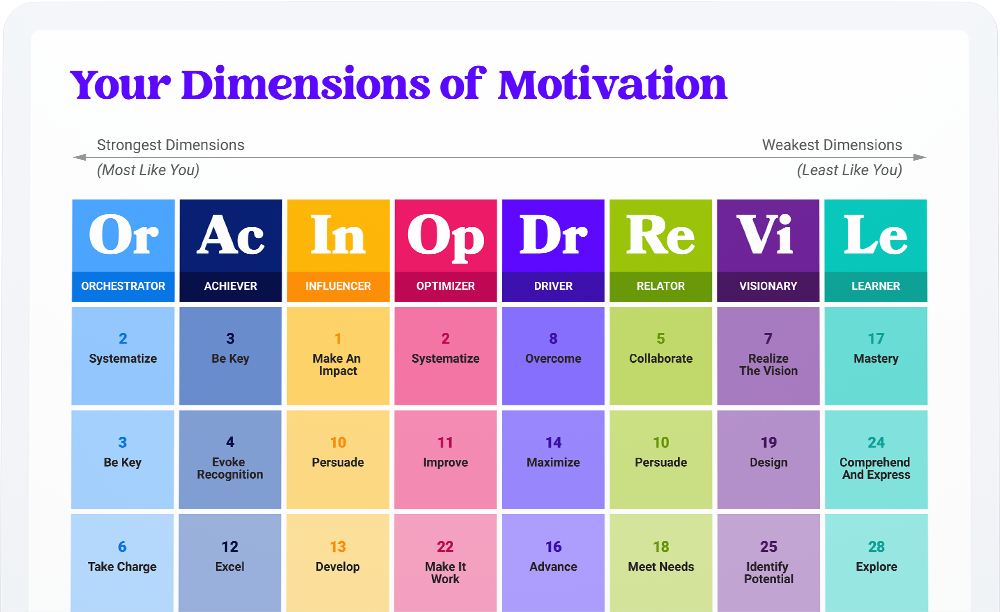
Motivation Code is a motivational intelligence system built on 60+ years of research using SIMA® (System for Identifying Motivated Abilities) and the analysis of over 1.8M personal achievement stories. The story-based MCode assessment identifies an individual’s ranking of 32 Motivations mapped to 8 Motivational Dimensions: Achiever, Driver, Influencer, Learner, Optimizer, Orchestrator, Relator, and Visionary — powering a full ecosystem of tools that help organizations hire smarter, build stronger teams, develop talent, and sustain engagement over time.
Behavioral fit vs. Motivational alignment:
Culture Index assesses whether an individual’s behavioral traits align with the demands of a specific role — a useful filter for identifying candidates who are likely to function well within a defined set of job requirements. MCode assesses whether an individual’s intrinsic motivations align with the actual work they’ll be doing, the manager they’ll be working with, and the environment they’ll be operating in. Behavioral fit predicts functional compatibility; motivational alignment predicts sustained engagement, peak performance, and long-term retention.
Organizational-level data vs. Individual-level intelligence:
Culture Index produces behavioral profiles that executives and advisors use to make organizational decisions — who to hire, how to structure teams, and where performance gaps may exist. The intelligence is primarily useful at the decision-making level. MCode produces deeply personal motivational profiles that every individual can own, understand, and apply, while also giving leaders the team-level maps and performance data they need to lead more effectively. When everyone on a team understands their own motivational wiring and that of their colleagues, the insight produces change at both the individual and organizational level.
Point-in-time survey vs. Sustained performance platform:
Culture Index recommends re-administration when roles or reporting structures change, treating the survey as a periodic data point within a broader advisory relationship. The Motivation Code platform is designed for continuous use, offering leaders ongoing motivational intelligence that evolves with their teams — tracking engagement over time, surfacing at-risk individuals, and providing data-driven guidance on assignments, development, and communication. Motivational intelligence doesn’t expire; the platform ensures it stays active and actionable.
MCode vs Culture Index Features Comparison
Motivation Code (MCode) and Culture Index both help organizations make better decisions about their people, but they do so from fundamentally different angles. Culture Index assesses behavioral traits to evaluate role fit within an advisory-supported framework. MCode assesses intrinsic motivation to reveal what drives each person to engage, perform, and stay, and delivers an ecosystem of tools that operationalize that insight across the full talent lifecycle.
MCode
Culture Index
Assessment concept
Identifies the intrinsic motivations that fuel engagement, performance, and fulfillment, revealing what drives a person’s thoughts, decisions, and actions and what they need from their work to perform at their best.
Measures seven behavioral personality traits to assess how an individual’s natural tendencies align with the demands of a specific role and the broader organizational culture.
Assessment framework
A ranking of 32 Motivations mapped to 8 Motivational Dimensions: Achiever, Driver, Influencer, Learner, Optimizer, Orchestrator, Relator, and Visionary.
Seven behavioral constructs: Autonomy, Social-ability, Patience, Conformity, Energy, Logic, and Ingenuity, measured against job-specific behavioral benchmarks.
Assessment origins
Based on the System for Identifying Motivated Abilities (SIMA), developed by Art Miller in the 1950s. Originally administered through in-depth interviews. Technology brought the assessment online in the 2000s, and assets were unified under the Motivation Code brand in 2022.
Introduced in 2004, following five years of research and development. Built survey validation across job hierarchy samples representing both sexes. Positioned as a strategic talent management platform pairing behavioral data with executive advisory support.
Assessment science
Grounded in 60+ years of empirical science integrating narrative psychology, behavioral psychology, and motivational research. Built on the analysis of over 1.8M achievement stories to identify the motivational patterns that drive satisfaction, fulfillment, and high performance.
A self-report inventory validated using construct validity studies and factor analysis. Split-half reliability testing confirms reliability coefficients consistent with accepted psychometric standards. Administered research shows no evidence of bias by gender or race.
Assessment experience
Individuals share four personal achievement stories and answer questions about those experiences, rating satisfaction on a 1–10 scale.
Individuals complete a free-choice adjective checklist in two sections, selecting words that describe themselves and words that describe their job requirements.
Time to complete
Approximately 30 minutes.
Approximately 7-10 minutes.
Assessment consistency
Results are grounded in lived experiences and the emotions tied to them. Motivations remain consistent throughout life, making results stable. Re-testing is unnecessary.
Results are considered stable for established traits, but re-administration is recommended when roles, responsibilities, or reporting structures change significantly.
Assessment results
Reveals the motivational patterns that drive a person’s achievement — what energizes and drains them, how they’re wired for work, and why certain roles, partnerships, and assignments feel deeply satisfying while others feel like an obligation.
Produces a behavioral profile comparing an individual’s natural trait tendencies against the behavioral requirements of their role. Results highlight alignment and gaps, and are used to inform hiring, placement, management, and team-building decisions.
Assessment application
Hiring and job fit, employee engagement, talent development, team building, retention, burnout prevention, leadership development, and ongoing performance management.
Hiring and role alignment, team composition, leadership development, management coaching, and organizational strategy, supported by Culture Index executive advisors.
Assessment challenges
Individuals may feel pressure to choose stories that cast them in the best light, or find it difficult to decide which personal or professional stories to share.
Results can be susceptible to faking, as individuals may select adjectives based on perceived employer preferences rather than genuine self-description.
MCode
Culture Index
Assessment Concept
Identifies the intrinsic motivations that fuel engagement, performance, and fulfillment, revealing what drives a person’s thoughts, decisions, and actions and what they need from their work to perform at their best.
Measures seven behavioral personality traits to assess how an individual’s natural tendencies align with the demands of a specific role and the broader organizational culture.
Assessment framework
A ranking of 32 Motivations mapped to 8 Motivational Dimensions: Achiever, Driver, Influencer, Learner, Optimizer, Orchestrator, Relator, and Visionary.
Seven behavioral constructs: Autonomy, Social-ability, Patience, Conformity, Energy, Logic, and Ingenuity, measured against job-specific behavioral benchmarks.
Assessment origins
Based on the System for Identifying Motivated Abilities (SIMA), developed by Art Miller in the 1950s. Originally administered through in-depth interviews. Technology brought the assessment online in the 2000s, and assets were unified under the Motivation Code brand in 2022.
Introduced in 2004, following five years of research and development. Built on survey validation across job hierarchy samples representing both sexes. Positioned as a strategic talent management platform pairing behavioral data with executive advisory support.
Assessment science
Grounded in 60+ years of empirical science integrating narrative psychology, behavioral psychology, and motivational research. Built on the analysis of over 1.8M achievement stories to identify the motivational patterns that drive fulfillment and high performance.
A self-report inventory validated using construct validity studies and factor analysis. Split-half reliability testing confirms reliability coefficients consistent with accepted psychometric standards. Administered research shows no evidence of bias by gender or race.
Assessment experience
Individuals share four personal achievement stories and answer questions about those experiences, rating satisfaction on a 1–10 scale.
Individuals complete a free-choice adjective checklist in two sections, selecting words that describe themselves and words that describe their job requirements.
Time to complete
30 minutes.
7-10 minutes.
Assessment consistency
Results are grounded in lived experiences and the emotions tied to them. Motivations remain consistent throughout life, making results stable. Re-testing is unnecessary.
Results are considered stable for established traits, but re-administration is recommended when roles, responsibilities, or reporting structures change significantly.
Assessment results
Reveals the motivational patterns that drive a person’s achievement: what energizes and drains them, how they’re wired for work, and why certain roles, partnerships, and assignments feel deeply satisfying while others feel like an obligation.
Produces a behavioral profile comparing an individual’s natural trait tendencies against the behavioral requirements of their role. Results highlight alignment and gaps, and are used to inform hiring, placement, management, and team-building decisions.
Assessment application
Hiring and job fit, employee engagement, talent development, team building, retention, burnout prevention, leadership development, and ongoing performance management.
Hiring and role alignment, team composition, leadership development, management coaching, and organizational strategy, supported by Culture Index executive advisors.
Assessment challenges
Individuals may feel pressure to choose stories that cast them in the best light, or find it difficult to decide which personal or professional stories to share.
Results can be susceptible to faking, as individuals may select adjectives based on perceived employer preferences rather than genuine self-description.

A Culture Index alternative?
Maybe… Maybe not!
Culture Index is built for executives who want strategic leverage from their people data, and it delivers that within its advisory-supported model. The survey data, combined with the guidance of a Culture Index executive advisor, gives organizations a behavioral framework for making smarter decisions about hiring, placement, and team structure.
What that framework doesn’t include is motivational intelligence — the individual-level insight that explains why someone performs at their best in some conditions and quietly disengages in others. Organizations that add the Motivation Code platform to their people strategy gain that missing layer. Behavioral trait data and motivational intelligence address different questions, and the answers to both are worth having.
Here are five ways using both assessments creates better outcomes:
Hiring decisions with greater predictive depth:
Culture Index narrows the candidate pool by identifying whose behavioral traits align with the role’s demands. MCode, reveals which candidates fit the hiring manager and will be energized by the work, not just capable of performing it. Together, they provide a complete pre-hire picture of behavioral fit and motivational alignment that predicts hiring success.
Management at the individual level:
Culture Index gives managers a behavioral framework for understanding their team. MCode provides the motivational language to communicate with, develop, and engage each person individually. When leaders know how someone is behaviorally wired and what drives them, they can tailor their approach with a level of precision that generic management frameworks don’t support.
Development paths that drive results:
Motivation determines which development opportunities an individual will pursue with genuine investment and which they’ll treat as an obligation. Culture Index highlights behavioral strengths and gaps that inform training priorities. MCode identifies the motivational drivers that make those growth path priorities resonate, producing meaningful engagement and stronger outcomes.
Team composition that balances behavior and motivation:
Leaders need visibility into behavioral dynamics and motivational dynamics. Culture Index reveals functional gaps and behavioral patterns across a team. MCode adds motivational mapping, showing where team members are invigorated by their contributions and where they’re taxed by responsibilities. Leaders who understand both build teams that are functionally balanced and motivationally sustainable.
Retention rooted in fulfillment, not just satisfaction:
Culture Index helps identify cultural misalignment before it becomes a departure. MCode reveals the motivational misalignment that precedes most disengagement — the slow drain that happens when someone’s work consistently fails to tap into what fuels them. Together, these tools give organizations an earlier, more complete picture of retention risk, and a more targeted basis for intervention.
The MCode assessment powers job satisfaction and high-performing teams
Headhunters, executive coaches, recruiters, and leaders have been using this workplace assessment for decades, with companies like The Disney Institute, Merk, IBM, Aetna, The Mayo Clinic, New York Life, and Motorola, to identify job fit, increase engagement, develop talent, and build team cohesion.
Discover the MCode difference!