MCode vs CliftonStrengths
Knowing what you do best is a powerful starting point, but high-performance organizations need to go further. MCode reveals the motivational forces that determine whether someone’s strengths will be channeled, sustained, and deeply satisfying, or used out of obligation and depleted.

Strengths tell you what, motivation explains why
CliftonStrengths identifies an individual’s natural talents and the themes that describe what they do best. It’s valuable but incomplete. Someone can use a strength every day and still feel drained by their work, disengaged in their role, and ready to walk out the door. MCode fills that gap by identifying the Motivations that determine whether the work someone is doing with their strengths is life-giving or taxing.
- An individual’s CliftonStrengths themes describe their natural patterns of thinking, feeling, and behaving. Their MCode explains what has to be true about their work for those patterns to generate energy and satisfaction rather than burnout.
- Two people can share the same top CliftonStrengths themes and perform the same role in completely different ways because their Motivations are distinct. MCode reveals that distinction and makes it actionable.
When leaders understand both the strengths their people bring and the motivations that fuel those strengths, they stop guessing what will drive engagement and start designing for it.


Results grounded in lived experience
CliftonStrengths asks individuals to respond to 177 paired statements in 20 seconds each, fast by design, to capture instinctive reactions rather than deliberate self-presentation. MCode goes further by grounding results in real, lived experience rather than reactive self-reporting.
- The MCode assessment starts with personal stories of achievement, moments when an individual was fully engaged, performing at their best, and finding the work genuinely fulfilling.
- Questions are specific to those stories and ask individuals to rate satisfaction on a 1–10 scale. Results are built from what actually happened, not from how someone perceives themselves in the abstract.
Because MCode is rooted in actual experiences rather than self-description, results carry a depth and specificity that make them immediately recognizable and immediately applicable.
Motivation-aligned development
CliftonStrengths provides a framework for strengths-based development: Invest in your top themes, find partners to cover your weaker ones, and build your talents into true strengths. MCode adds the motivational layer that makes development stick.
- When development opportunities align with an individual’s Top Motivations, engagement is higher, productivity skyrockets, progress comes faster, and the work feels worth doing.
- Leaders who understand each team member’s motivational wiring can design growth paths that challenge people in the ways that excite them, and avoid activities and tasks that drain them.
- Organizations that combine strengths awareness with motivational intelligence build cultures where people don’t just perform, they thrive.
MCode makes it possible to invest in the right development for the right person, not just the most obvious development based on what they’re already good at.

Strengths assessment
vs. Motivational assessment
The CliftonStrengths assessment identifies an individual’s unique rank of 34 talent themes, organized across four domains: Executing, Influencing, Relationship Building, and Strategic Thinking. Developed by Don Clifton and administered by Gallup, it measures natural patterns of thinking, feeling, and behaving. CliftonStrengths is built on the principle that people perform best when they invest in their natural talents. Talent, in the StrengthsFinder framework, becomes a strength when combined with knowledge, skills, and deliberate practice.
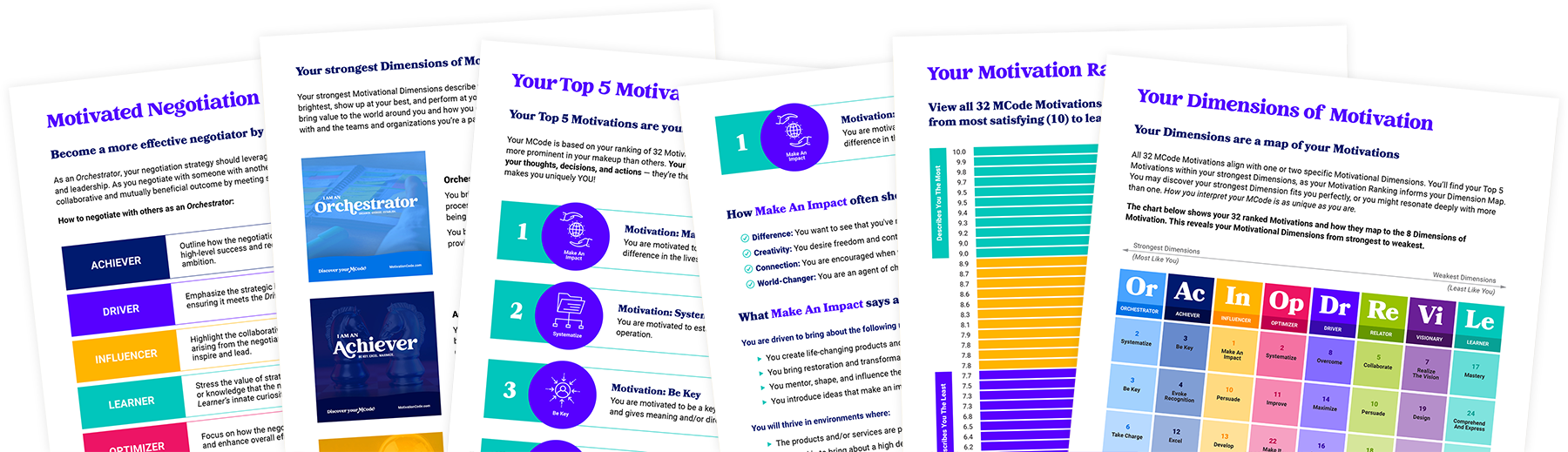
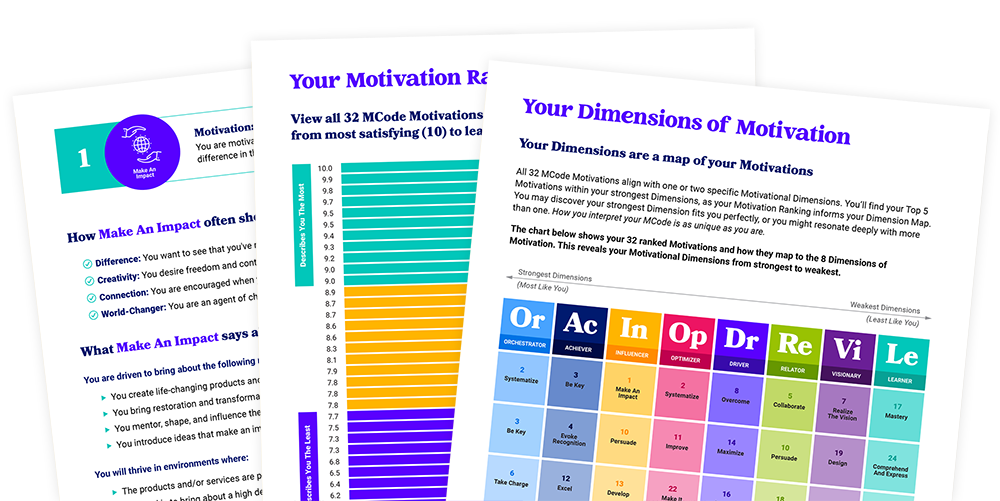
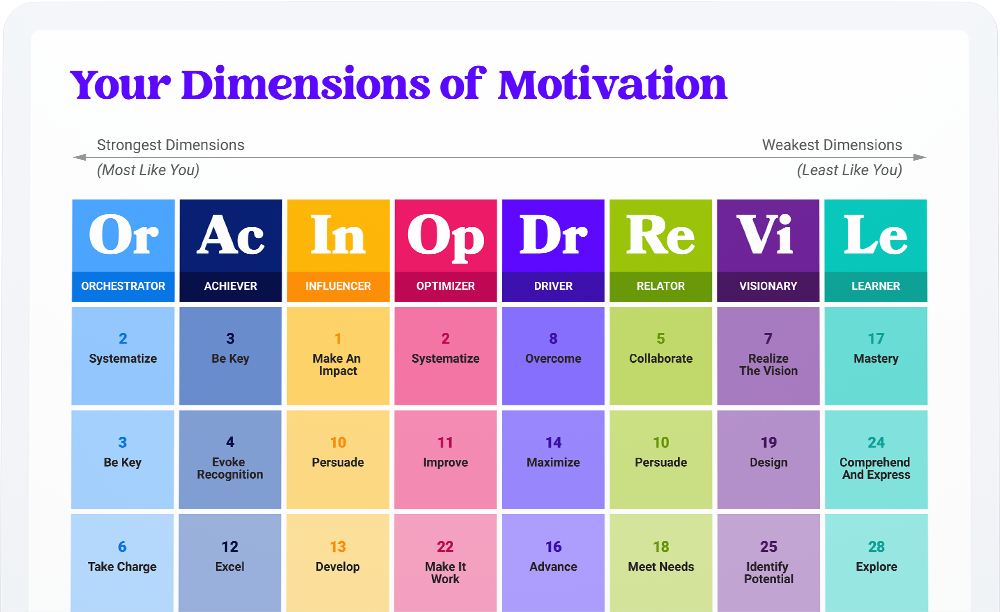
The MCode assessment reveals an individual’s ranking of 32 Motivations mapped to 8 Motivational Dimensions: Achiever, Driver, Influencer, Learner, Optimizer, Orchestrator, Relator, and Visionary. Built on 60+ years of motivational science and the analysis of over 1.8M personal achievement stories, MCode identifies what drives someone to engage, persist, and perform at their best. Where CliftonStrengths describes the talents someone has, MCode explains the conditions under which those talents will be fully expressed.
Aspiration vs. Satisfaction
CliftonStrengths is built on an investment model: talent multiplied by deliberate practice produces strength. The framework encourages individuals to lean into their top themes and build on them. MCode is built on a satisfaction model, analyzing what has already produced deep fulfillment in an individual’s life to surface the motivational patterns that are most consistent and most powerful. CliftonStrengths points toward what someone could become. MCode reveals what has always been true about them.
Talent vs. Motivation
CliftonStrengths reveals the natural abilities that give an individual their greatest opportunity for excellence — the recurring patterns of thought and behavior that, when developed, become their strongest contributions. MCode identifies the intrinsic motivations that determine whether an individual will be energized or depleted by the work they’re doing with those abilities. A person can be highly talented in a theme and still feel disengaged if the work fails to connect with their core Motivations.
Development vs. Alignment
CliftonStrengths supports strengths-based development by helping individuals and leaders understand where investment will yield the highest return. MCode supports motivational alignment by helping organizations ensure that the work people are doing with their strengths connects with what intrinsically drives them. Development without alignment produces capable employees who are disengaged. Alignment without development produces engaged employees who plateau. Together, the two assessments address both employee performance dynamics.
MCode vs CliftonStrengths Features Comparison
The MCode assessment and CliftonStrengths (formerly StrengthsFinder) reflect two distinct but complementary approaches to understanding human performance. CliftonStrengths focuses on identifying natural talents and building them into strengths. MCode focuses on identifying the intrinsic motivations that determine whether those strengths will be fully engaged and deeply satisfying.
MCode
CliftonStrengths
Assessment concept
Uncovers the intrinsic motivations that fuel an individual’s engagement, performance, and fulfillment — the “why” behind what drives them to do their best work.
Identifies talent themes, representing what an individual does best and where they have the greatest opportunity to build strength through investment and practice.
Assessment framework
A ranking of 32 Motivations mapped across 8 Motivational Dimensions: Achiever, Driver, Influencer, Learner, Optimizer, Orchestrator, Relator, and Visionary.
A ranked sequence of 34 talent themes organized across four domains: Executing, Influencing, Relationship Building, and Strategic Thinking.
Assessment origins
Based on the System for Identifying Motivated Abilities (SIMA), developed by Art Miller in the 1950s to study the intrinsic motivations of high-performing individuals. Originally administered through in-depth interviews, then brought online with the introduction of technology, improving scalability, consistency, and objectivity.
Developed by educational psychologist Don Clifton at Gallup in the 1990s, based on decades of research into what makes top performers stand out. Originally published as the Clifton StrengthsFinder alongside the book Now, Discover Your Strengths, then rebranded as CliftonStrengths after Clifton’s death in 2003.
Assessment science
Grounded in 60+ years of empirical science, integrating narrative psychology, behavioral psychology, and motivational research. Built on the analysis of over one million personal achievement stories to identify the motivational patterns that drive fulfillment and high performance.
Rooted in positive psychology and the question: What would happen if people focused on what is right with them? Built on decades of study of characteristics of top performers, distilled into 34 talent themes. Gallup reports strong test-retest reliability, with rankings remaining stable over time.
Assessment experience
Individuals share four personal achievement stories and answer questions about those experiences, rating satisfaction on a 1–10 scale. Takes approximately 30 minutes and delivers results immediately.
Individuals respond to 177 paired statements in 30–45 minutes, choosing which best describes them. The 20-second response window per item captures instinctive reactions.
Time to complete
Approximately 30 minutes.
Approximately 30-45 minutes.
Assessment consistency
Results are grounded in real, lived experiences and the emotions tied to them. Core Motivations remain consistent throughout life, with high test-retest reliability. Results are available only through Motivation Code, ensuring the experience and report are always the same.
Gallup reports high test-retest reliability and strong long-term stability. Theme rankings are expected to remain consistent over years. Gallup generally advises against retaking the assessment unless the original was taken under distracting circumstances or very early in life.
Assessment application
Hiring and job fit, employee engagement, talent development, retention, burnout prevention, team building, and leadership development.
Personal development, career planning, strengths-based coaching, team building, employee engagement, and leadership development.
Assessment challenges
Individuals may feel pressure to choose stories that cast them in the best light, or find it difficult to decide which personal or professional stories to share.
The forced-choice format and 20-second response window can feel rushed. Results describe talents but do not explain whether an individual will be motivated or fulfilled by the work that uses those talents.
MCode
CliftonStrengths
Assessment concept
Uncovers the intrinsic motivations that fuel an individual’s engagement, performance, and fulfillment — the “why” behind what drives them to do their best work.
Identifies talent themes, representing what an individual does best and where they have the greatest opportunity to build strength through investment and practice.
Assessment framework
A ranking of 32 Motivations mapped across 8 Motivational Dimensions: Achiever, Driver, Influencer, Learner, Optimizer, Orchestrator, Relator, and Visionary.
A ranked sequence of 34 talent themes organized across four domains: Executing, Influencing, Relationship Building, and Strategic Thinking.
Assessment origins
Based on the System for Identifying Motivated Abilities (SIMA), developed by Art Miller in the 1950s to study the intrinsic motivations of high-performing individuals. Originally administered through in-depth interviews, then brought online with the introduction of technology, improving scalability, consistency, and objectivity.
Developed by educational psychologist Don Clifton at Gallup in the 1990s, based on decades of research into what makes top performers stand out. Originally published as the Clifton StrengthsFinder alongside the book Now, Discover Your Strengths, then rebranded as CliftonStrengths after Clifton’s death in 2003.
Assessment science
Grounded in 60+ years of empirical science, integrating narrative psychology, behavioral psychology, and motivational research. Built on the analysis of over one million personal achievement stories to identify the motivational patterns that drive fulfillment and high performance.
Rooted in positive psychology and the question: What would happen if people focused on what is right with them? Built on decades of study of characteristics of top performers, distilled into 34 talent themes. Gallup reports strong test-retest reliability, with rankings remaining stable over time.
Assessment experience
Individuals share four personal achievement stories and answer questions about those experiences, rating satisfaction on a 1–10 scale. Takes approximately 30 minutes and delivers results immediately.
Individuals respond to 177 paired statements in 30–45 minutes, choosing which best describes them. The 20-second response window per item captures instinctive reactions.
Time to complete
Approximately 30 minutes.
About 30-45 minutes.
Assessment consistency
Results are grounded in real, lived experiences and the emotions tied to them. Core Motivations remain consistent throughout life, with high test-retest reliability. Results are available only through Motivation Code, ensuring the experience and report are always the same.
Gallup reports high test-retest reliability and strong long-term stability. Theme rankings are expected to remain consistent over years. Gallup generally advises against retaking the assessment unless the original was taken under distracting circumstances or very early in life.
Assessment applications
Hiring and job fit, employee engagement, talent development, retention, burnout prevention, team building, and leadership development.
Personal development, career planning, strengths-based coaching, team building, employee engagement, and leadership development.
Assessment challenges
Individuals may feel pressure to choose stories that cast them in the best light, or find it difficult to decide which personal or professional stories to share.
The forced-choice format and 20-second response window can feel rushed. Results describe talents but do not explain whether an individual will be motivated or fulfilled by the work that uses those talents.

A CliftonStrengths alternative?
Maybe… Maybe not!
CliftonStrengths, previously called StrengthsFinder and StrengthsFinder 2.0, is one of the most widely used and well-regarded assessment tools in the world. It gives individuals and organizations a clear, research-backed framework for understanding natural talent and building on it. The question isn’t whether to use it — it’s whether strengths awareness alone is enough to drive sustained high performance and genuine fulfillment.
MCode answers what CliftonStrengths leaves open: Why someone’s strengths produce energy and engagement in some contexts and feel like an obligation in others. When organizations use both assessments together, they gain a complete picture of their people — what they’re capable of and what will keep them fully invested in doing it.
Here are five ways using both assessments creates better outcomes:
Personalized leadership that drives performance:
Leaders who understand both the strengths and the motivations of each team member can tailor their approach with precision. CliftonStrengths tells a leader what a person does best. MCode tells them what conditions will bring out that best work consistently. That combination makes it possible to assign the right work to the right person, and communicate about it in a way that resonates.
Hiring decisions with more depth:
CliftonStrengths helps identify candidates whose talent profiles match the demands of a role. MCode adds the motivational layer, revealing whether a candidate will be energized by the work itself, not just capable of performing it. Together, they reduce the risk of hiring someone who looks right on paper but disengages once the novelty wears off.
Team composition that prevents burnout:
CliftonStrengths helps teams understand their diverse talents, and how they complement one another. MCode adds awareness of motivational dynamics, identifying where team members are energized by contributions and where their responsibilities deplete them. Organizations that leverage both dimensions can build teams that are high-performing and sustainable long-term.
Strengths-based development that sticks:
CliftonStrengths identifies the talent themes where an individual has the greatest potential for excellence. MCode reveals which development opportunities will feel genuinely interesting and compelling — the ones that tap into what someone is intrinsically motivated to pursue. When growth paths align with both natural talent and core motivation, individuals engage more deeply, progress faster, and stay committed longer.
Retention rooted in fulfillment, not just engagement:
Employees who feel their work plays to their strengths report higher engagement. Employees whose work also aligns with their core Motivations report deeper fulfillment, and they stay. MCode and CliftonStrengths together give organizations the insight to design roles, assignments, and growth opportunities that address both dimensions, creating the conditions where top performers don’t just perform — they have no reason to leave.
The MCode assessment powers job satisfaction and high-performing teams
Headhunters, executive coaches, recruiters, and leaders have been using this workplace assessment for decades, with companies like The Disney Institute, Merk, IBM, Aetna, The Mayo Clinic, New York Life, and Motorola, to identify job fit, increase engagement, develop talent, and build team cohesion.
Discover the MCode difference!