Case Study
The Federal Authority Cyber Threat Team solves a recurring performance challenge
A 40-person cyber threat team finally understood why their best people kept colliding instead of coordinating. Months later, they still use MCode language daily as a strategic advantage.

The problem
A cyber threat team at a U.S. regulatory authority built exactly the kind of team you’d expect for high-stakes incident response: 40 people, almost all of them wired to act fast, take charge, and drive toward resolution.
When a security threat hit, they moved. But there was a pattern no one could name.
A problem would surface, seven people would immediately propose seven different solutions, and seven people would launch seven different approaches — simultaneously. Most approaches required coordination, but everyone was already running. Those that were finished were the rare single-person jobs. The rest stalled, half-built, while the team scrambled to regroup.
One of the key leaders described it later as “too many cooks in the kitchen producing a lot of half-made food.”
The team had used DISC assessments for years.
Profiles were posted on desks, and everyone knew their behavioral style. But in a high-urgency, constantly shifting environment, where the situation changes moment to moment, and people figure things out in real time, knowing how someone behaves under stress didn’t translate into knowing why they respond the way they do.
DISC had become a badge, not a behavioral change tool.
People appreciated it, but nothing changed because of it. The annual off-site would come and go. The team would reconvene, review their profiles, have some good conversations, and return to work operating exactly as they had before.
The catalyst
One of the team’s key leaders had taken the MCode Assessment independently and believed it could offer something DISC hadn’t. She advocated for bringing MCode to the leadership team’s upcoming off-site — not to replace DISC, but to answer the question underneath it.
The proposal: All four members of the leadership team would take MCode first.
One of those leaders was openly skeptical. He’d seen assessments before — boilerplate results, copy-paste language, and nothing that felt specific enough to act on — and he didn’t believe assessments could tell him anything he didn’t already know. But he took the assessment anyway.
The turning point
After the leadership team completed their MCode assessments, they held two follow-up meetings to discuss their results together, and the skeptic’s response caught everyone off guard: “This is fantastic. This was so deadly accurate. This is incredible. I’ve never taken anything like this.”
The leader who had dismissed assessments as generic became the most vocal advocate.
The leadership team made an immediate decision for all 40 people on the team to take the MCode assessment, and to include a full team training session at their upcoming off-site. But they had one specific question they wanted answered: “How do we connect the dots between MCode and DISC?”
The answer reframed how they thought about both tools.
- DISC describes what — how people behave, especially under pressure.
- MCode reveals why — the motivational forces that drive that behavior.
These aren’t competing frameworks.
DISC and MCode are different layers of the same picture. Understanding both gives leaders a complete view of how someone shows up and what’s driving them when they do — something neither tool delivers alone.
The training session opened by revisiting the team’s existing DISC results, then walked through the motivational patterns underneath those behaviors.
The discovery
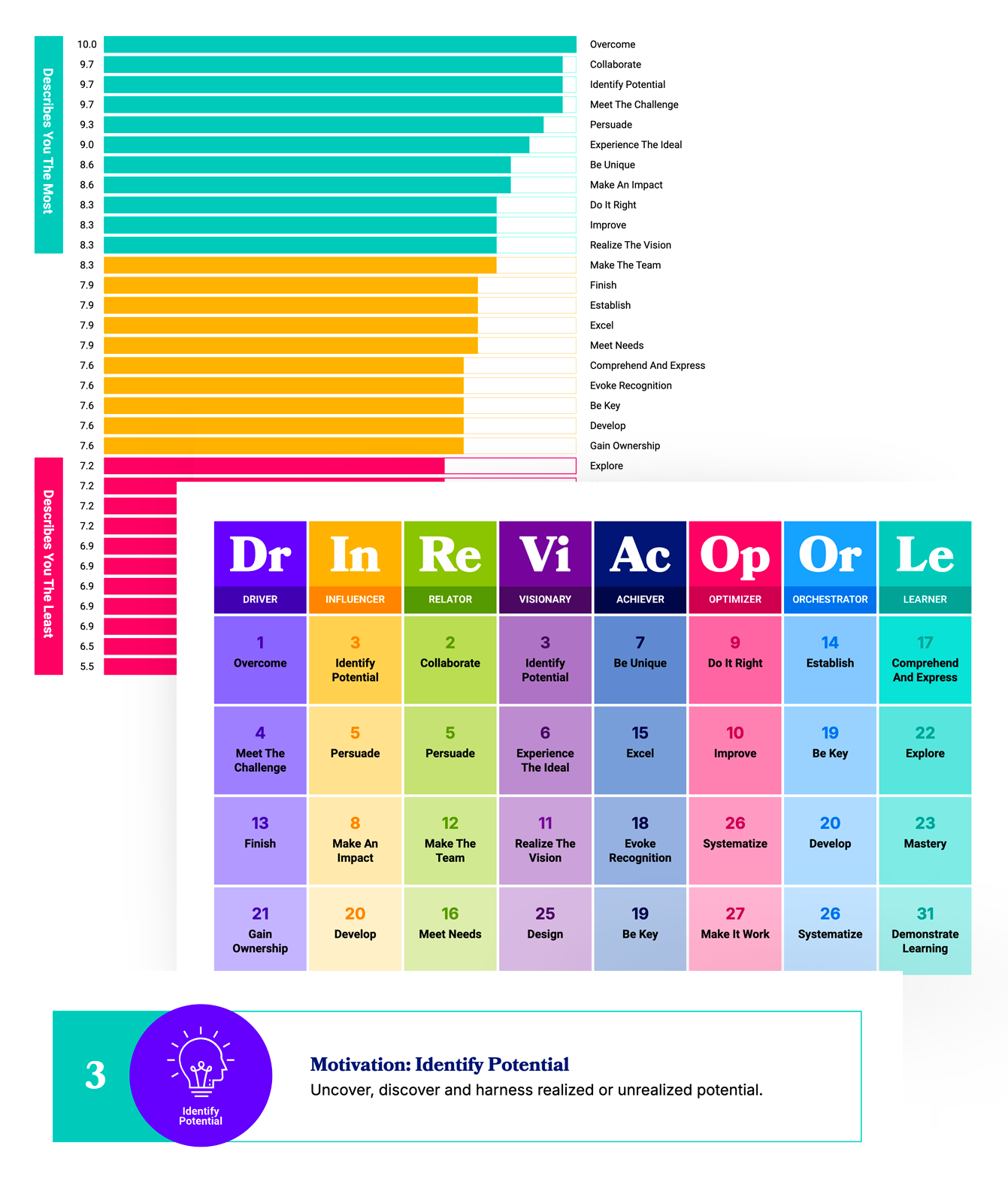
When the full team’s MCode results were mapped, one pattern dominated everything. Out of 40 people, roughly 28 to 30 were wired identically.
Nearly three-quarters of the team were Drivers — motivated by challenges, forward momentum, and taking decisive action. For a cyber threat response team, this made perfect sense. You want people who are wired to move fast and take charge when a security threat hits. The team had been hiring this way intuitively for years.
But when almost everyone on a team is driven to act, lead, and solve simultaneously, you get a predictable problem. Not a personality conflict. A motivational pile-up. Every new threat triggers a room full of people all wired to take the lead and move fast, resulting in a lot of energy spent, not all of it productive.
The MCode training gave the team language to name what had been happening and start navigating it differently. Instead of seven people launching seven approaches, they could now ask: “Given that we have this many drivers in the room, how do we structure our response so that drive becomes coordination instead of competition?”
What’s interesting is that the originally skeptical leader, the one who’d called his results “deadly accurate,” turned out to be one of the few people on the team who wasn’t wired as a Driver. MCode gave him new language to articulate why he’d always felt like an outlier on his own team. His motivational wiring was different from the majority, and once understood, that difference became a strategic asset instead of an unexplained source of friction.
The impact
The team loved the workshop session at the off-site, finding it valuable and saying it was the best session they’d had. But positive off-site feedback is the baseline. Every good workshop gets that reaction. The more important question is always the same: What happens after everyone goes back to work?
Four months later, the answer arrived
The leader who had championed MCode internally reached out, not because the organization scheduled a follow-up, but because the team was using MCode language in their daily interactions and wanted more. They wanted additional exercises, next steps, and tools to keep building on what they’d started.
Her feedback captured what had shifted:
“MCode team training was thoughtfully curated to incorporate the specific and unique needs of our team. A tailored session that blended our previous DISC (behavior) and MCode (motivation) performances to elevate our team’s ecosystem and cultivate the building blocks for meaningful and impactful engagement. We will benefit from this for years to come.”
What changed
The team didn’t abandon DISC or reorganize their structure. What they did was more subtle and, in many ways, more durable. They gained a shared framework for understanding why their team operates the way it does, and a vocabulary for navigating it.
When you know that 30 of your 40 people are wired to take charge simultaneously, you stop treating coordination problems as personal conflicts and start treating them as a structural pattern you can design around. The problem doesn’t disappear — a team of Drivers will always want to drive — but the awareness changes how they channel that energy.
The evidence that it stuck doesn’t show up in off-site feedback forms. It is evident in the fact that four months later, the team was still using the language, building on the foundation, and asking for more. When assessment vocabulary becomes everyday vocabulary — when people reference it in meetings, use it to navigate friction, and proactively ask for the next layer of development — that’s when you know something fundamentally shifted within the team, and the framework they have adopted can be built on for years to come.
Take the MCode assessment
Use 60+ years of validated motivation science to make confident hiring decisions, develop effective leaders, build teams that perform at their peak, and create a workplace culture employees never want to leave.
Try it yourself and see the difference.
Choose MCode Lite or MCode Premium and discover your MCode in 30 minutes or less to gain clarity on what fuels your success and start speaking the language of motivation!