

Case Study
Kristen Hadeed’s new book comes with a next step
Kristen’s new book, Human Leadership, is out. When readers finish it, they can take Mirror Moment, an assessment built from the book. It shows a leader where they stand today and what to work on next.
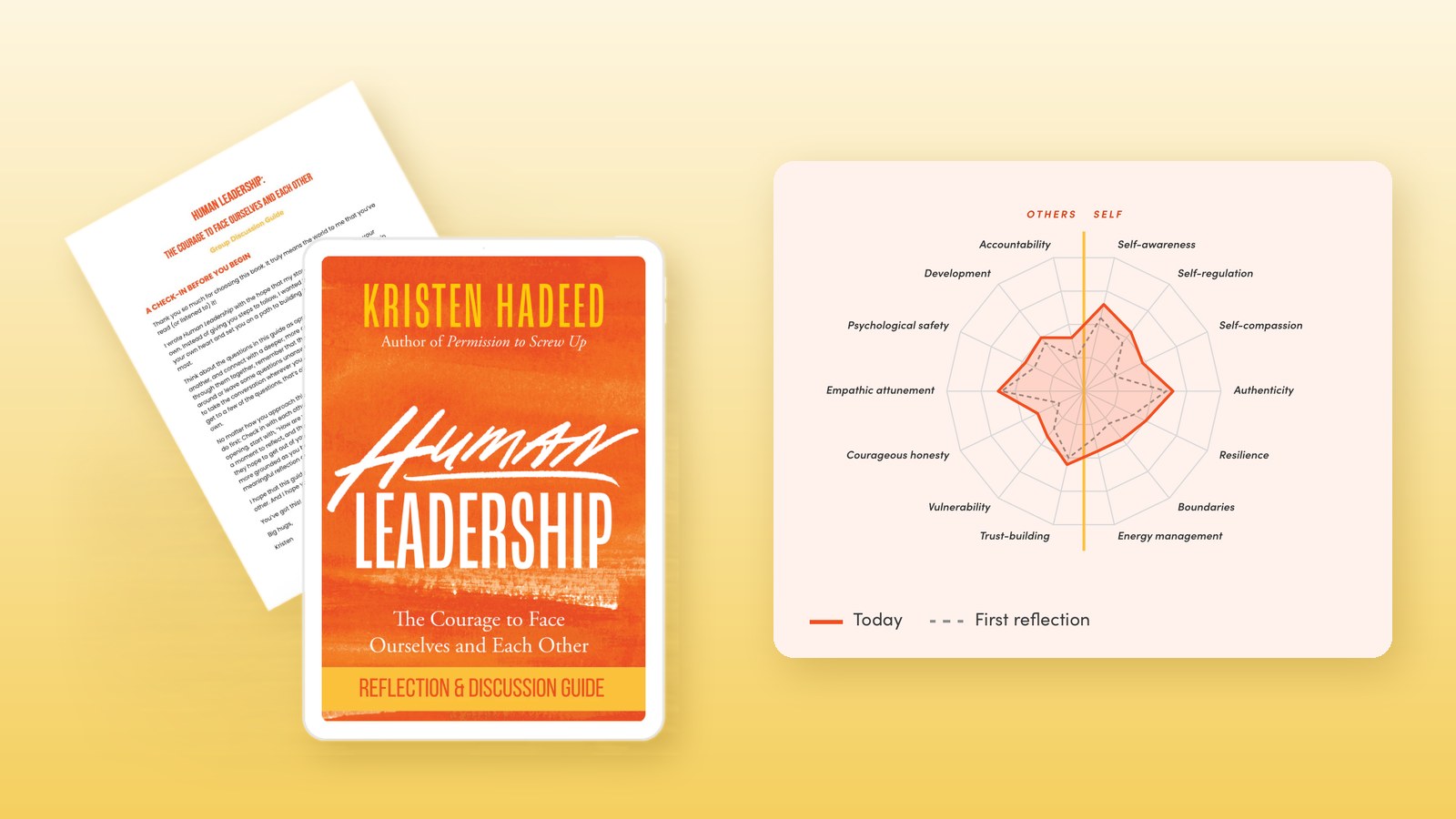
This is the story of how Kristen, her team, and our team built Mirror Moment together. It’s also a guide for any author who wants their book to keep working after the last page.
A book of stories, on purpose
Kristen didn’t write a how-to book. She wrote stories about leading people. Some are times she got it right. Some are times she got it badly wrong. She wanted readers to see themselves in those stories and think about their own work.
“I was very intentional about making it a story instead of a step-by-step guide. Because I didn’t have practical advice in the book, I wanted to give readers a next step. And I thought an assessment would be a wonderful way to do that.”
— Kristen Hadeed
Most books end the same way. The reader closes the cover, feels inspired for a few days, and then life gets busy. The ideas fade, and the author never finds out what happened next. Kristen wanted something that picks up where the book leaves off.
Finding the framework inside the stories
Here’s the hard part. You can’t measure yourself against a story. Someone has to find the ideas that keep showing up across the stories and give them a shape. That’s very hard to do with your own book.
“When you’re so close to your work, it’s really hard to see how to turn that into something like an assessment. This book was so personal and so story-based that I was having trouble pulling out the main themes.”
— Kristen Hadeed
That’s where we came in. We read the manuscript closely and pulled out the big ideas that kept coming up. We found 14 of them, split into two halves. Seven are about how you treat yourself. Seven are about how you treat others.
How you treat yourself
- Self-awareness
- Self-regulation
- Self-compassion
- Authenticity
- Failure
- Boundaries
- Energy
How you treat others
- Trust-building
- Vulnerability
- Courageous honesty
- Empathic attunement
- Psychological safety
- Developing others
- Accountability
For each idea, we built a ladder with five steps. Each step describes what that idea looks like as a leader grows. Self-awareness, for example, climbs from Unknowing to Noticing to Inquiring to Rewriting to Owning.
Step 1
Unknowing
Step 2
Noticing
Step 3
Inquiring
Step 4
Rewriting
Step 5
Owning
The self-awareness ladder. A higher step doesn’t mean you’re a better person. It means you’ve done more of the work.
Then we handed it to Kristen. She didn’t have to start from a blank page. She had something real to react to, and she reshaped the steps until they matched how she sees leadership.
Turning the framework into questions
Next came five questions for every idea. That’s 70 questions in all. Each one starts a sentence and offers five ways to finish it. Each answer lines up with one step on the ladder.
When I’m triggered, I…
None of the answers looks like the “right” one. They’re all written as plain, honest sentences, and the questions and answers are shuffled. People can’t game it. They just pick what’s true for them. It takes about 15 minutes.
Kristen made every word hers
This is where the work split the right way. Each team did the part it does best.
Kristen and her team
- The stories and the point of view
- Every question, in her words
- How the report should sound and feel
Our team
- The 14 ideas and their ladders
- Scoring and patterns
- The app and the report engine
“What I really loved was thinking about the experience of the person taking it, and the words that we chose. Intentionally choosing words that would lead to the feelings that I want them to have when they’re taking this assessment.”
— Kristen Hadeed
Kristen rewrote all 70 questions herself. Later, she went through the report line by line until it sounded like her. We sent her clean documents showing every word a reader would see, and each round of her edits went straight into the app.
We told her early on that we weren’t attached to any of it. It’s her book and her brand. That made it easy for her team to change whatever they needed to. Every change is saved as a new version, so when she improves a question, nobody’s old report changes on them.
What readers get at the end
When someone finishes, they don’t get a grade. They get a report written in Kristen’s voice: warm, direct, and honest without being harsh.
It shows two simple pictures of where they are today, one for how they treat themselves and one for how they treat others. It names their top strengths and the areas that need their attention. For each of the 14 ideas, it tells them where they are now, what the next step looks like, and a question to think about.
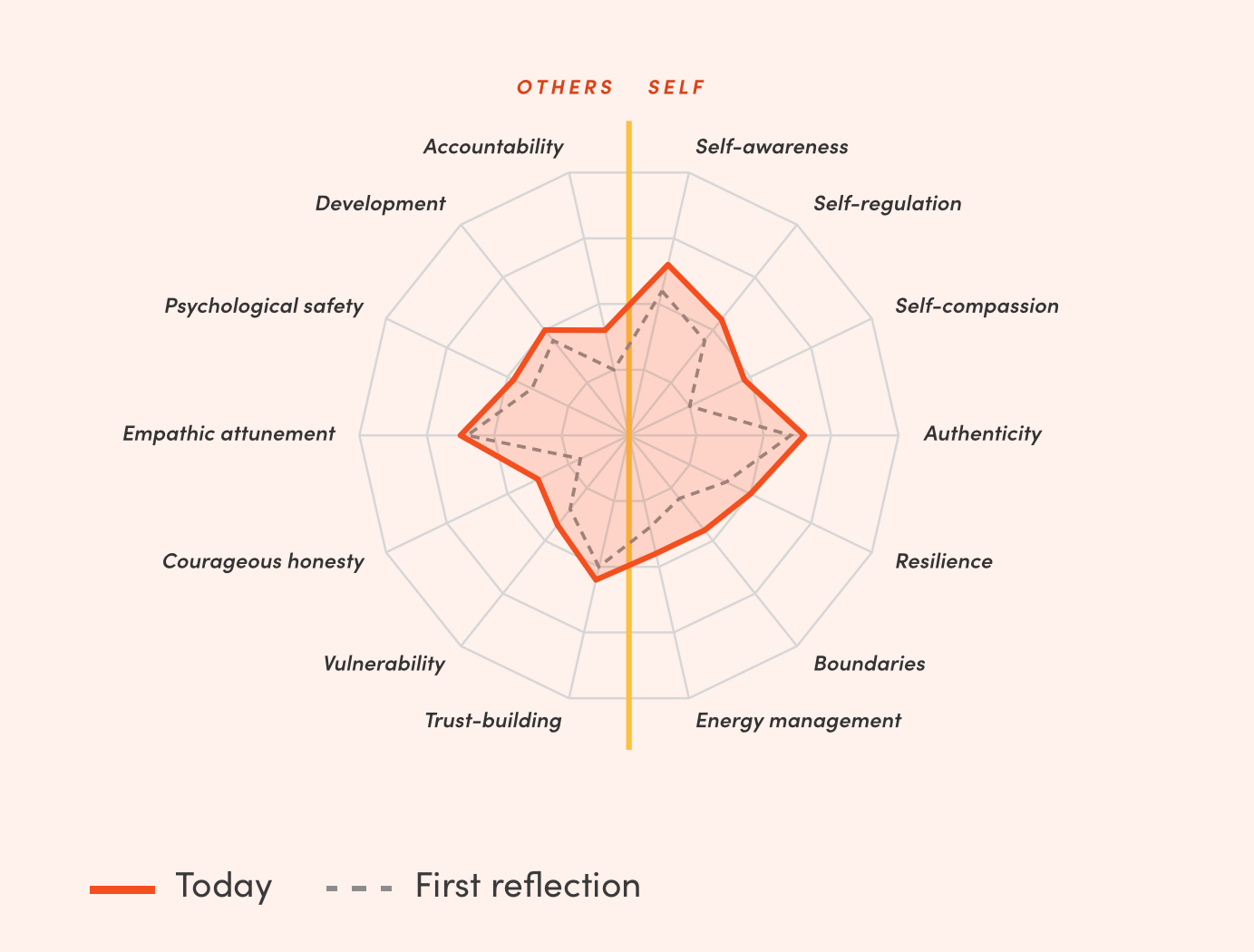
An example chart from the Mirror Moment dashboard.
The report also looks for patterns. These are combinations of answers that the book talks about. Someone who is great at sensing other people’s feelings but weak on boundaries might see “Empathy without boundaries.”
- Empathy without boundaries
- Extending compassion to everyone but yourself
- Support without standards
- Playing it too safe
- The pressure cooker
“This assessment isn’t one that puts somebody in a box. It allows them to be human and to grow. There isn’t a perfect score. The goal is just to continue growing as a human and a leader.”
— Kristen Hadeed
The first readers took it
When the first people finished Mirror Moment and wrote about it, everyone on both teams was excited and a little scared. A lot of heart went into this. Kristen said hearing their responses was “so validating.” People told her it made them think about how they treat themselves and others, and they liked learning how to grow in each area.
Mirror Moment is a real product, not a bonus page. A leader can buy it for $49 and retake it as often as they like to see how they’ve grown. Companies can buy spots for their whole team. Every report stays private. A boss can see that someone finished, but can only read the report if that person chooses to share it.
If you want to do this with your book
Here’s what we learned building Mirror Moment with Kristen.
- Your stories already hold a framework.
You don’t need a model before you start. You need a book with a clear point of view. The ideas are in there. - Someone outside the book should find it.
You’re too close to your own work to see the shape of it. Kristen said so herself. That’s normal, not a weakness. - React to a draft instead of a blank page.
Kristen moved fast because she had a framework to push against. Plan on several rounds of changes. - Own every word.
The questions and the report should sound like you. Expect to rewrite them, and work with people who won’t be hurt when you do. - Build it to be taken again.
Readers can retake it and see their growth. Teams can buy it together. A book someone reads once becomes something they come back to.
It took all of us
Kristen brought the stories and the voice. Her team cared about how every reader would feel. Our team brought the structure and built the app. Together, we built something none of us could have built alone.
Congratulations to Kristen and her team on the launch of Human Leadership and Mirror Moment.
If you’re an author and you think your book has a next step in it, we’d love to talk.